

 Silver Spring's downtown will soon be the heart of an Art and Entertainment District as Montgomery County swaps a shuttered JCPenney for the Fillmore Music Hall, inspired by the original Fillmore in San Francisco. Courtesy of Live Nation music company and Lee Development Group, the venue will sit on Colesville Road between Georgia Avenue and Fenton Street, across from the AFI Silver Theater and down the street from Discovery Communications. In an interesting swap, Lee, which owns the building, will build the new music hall for the county, and both the state and county will contribute $4 million toward construction. The developer will give the Fillmore property (valued at $3.5 million) to the county in exchange for land use allowances on an adjoining property at 8615 Georgia Avenue, currently planned to include a hotel and office buildings.
 The Fillmore will be a historic reuse project, maintaining the exterior of the old department store that has been vacant for almost 20 years. The new theater could have capacity ranging between 500 and 2,000, depending on the type of performances. The design for the project is by Hickok Cole Architects which is also behind the design for Lee's planned hotel and commercial buildings at Georgia Avenue, which will back up to the Fillmore.
The project planned for Georgia Avenue will bring a 12-story Class A Office Space and a 14-story 3 Star Hotel to the 72,000 s.f. of land. The developer indicated the team was deep in the planning stages for the commercial and hotel project and had not yet been through any Planning reviews.
In November, the County approved the exchange, with assurances to the developer that the County will pay the developer for any costs it might incur resulting from interceding zoning changes that affect the office and hotel project.
The Fillmore will be a historic reuse project, maintaining the exterior of the old department store that has been vacant for almost 20 years. The new theater could have capacity ranging between 500 and 2,000, depending on the type of performances. The design for the project is by Hickok Cole Architects which is also behind the design for Lee's planned hotel and commercial buildings at Georgia Avenue, which will back up to the Fillmore.
The project planned for Georgia Avenue will bring a 12-story Class A Office Space and a 14-story 3 Star Hotel to the 72,000 s.f. of land. The developer indicated the team was deep in the planning stages for the commercial and hotel project and had not yet been through any Planning reviews.
In November, the County approved the exchange, with assurances to the developer that the County will pay the developer for any costs it might incur resulting from interceding zoning changes that affect the office and hotel project.  The exchange is an aberration from the normal process by which a developer's plan is approved contingent on community benefits. In this case, Lee is building the theater (the community benefit) and promising to give away land without prior project approval for the proposed hotel and office. To offset the risk of not receiving approval and having to adjust designs for the commercial development, Lee received promises from the County that it would pay development costs due to any new regulations imposed on the Georgia Avenue Property.
Construction for the music hall could begin by the end of this year, setting the Fillmore Music Hall for a grand opening in late 2011. The County expects a $700,000 yearly profit from the venue.
Photo by Lizzie Turkevich.
The exchange is an aberration from the normal process by which a developer's plan is approved contingent on community benefits. In this case, Lee is building the theater (the community benefit) and promising to give away land without prior project approval for the proposed hotel and office. To offset the risk of not receiving approval and having to adjust designs for the commercial development, Lee received promises from the County that it would pay development costs due to any new regulations imposed on the Georgia Avenue Property.
Construction for the music hall could begin by the end of this year, setting the Fillmore Music Hall for a grand opening in late 2011. The County expects a $700,000 yearly profit from the venue.
Photo by Lizzie Turkevich. Silver Spring commercial real estate and development news


 The project should deliver by April or May of this year.
The County's efforts to re-brand the Ripley District are crawling along, but the development movement so far looks promising for the future.
The project should deliver by April or May of this year.
The County's efforts to re-brand the Ripley District are crawling along, but the development movement so far looks promising for the future. 




 "We're probably talking 2011 or 2012 before anything is even torn down," predicts


 The two-hour NCPC soap opera belied the stringent federally-mandated design standards for the new behemoth, which leave few design elements up for debate.
The 1.7 million s.f. building, developed by
The two-hour NCPC soap opera belied the stringent federally-mandated design standards for the new behemoth, which leave few design elements up for debate.
The 1.7 million s.f. building, developed by  The planned remote inspection facility (RIF) was the reason for all the shouting and name calling at the NCPC meeting. The facility, which allows for dog inspection of vehicles prior to entering the main campus, will be located in a "secure area of the east campus, over 610 feet away from the office towers," according to the NCPC staff report.
  dge, and facade changes have increased the cost of the project to the government by between $15 and $18 million. Sholz said the final project costs are hard to estimate and it is "conceivable" that the added costs could be offset through various cost saving measures the group is taking.
Despite the hubbub, the designs received NCPC approval, though not unanimous, and Sholz said the project is on schedule for completion in 20 months.
On a technical note, the NCPC has an advisory role in reviewing federal projects in Northern Virginia in the "environs" if DC. Generally a project comes before the NCPC and does not begin construction until it receives final review with approval and recommendations. Mark Center is an odd exception to the processes and authorities of the NCPC in that the structure, despite lacking final approval, is already at advanced stages of construction in order to meet the BRAC federally mandated September 2011 timeline.
dge, and facade changes have increased the cost of the project to the government by between $15 and $18 million. Sholz said the final project costs are hard to estimate and it is "conceivable" that the added costs could be offset through various cost saving measures the group is taking.
Despite the hubbub, the designs received NCPC approval, though not unanimous, and Sholz said the project is on schedule for completion in 20 months.
On a technical note, the NCPC has an advisory role in reviewing federal projects in Northern Virginia in the "environs" if DC. Generally a project comes before the NCPC and does not begin construction until it receives final review with approval and recommendations. Mark Center is an odd exception to the processes and authorities of the NCPC in that the structure, despite lacking final approval, is already at advanced stages of construction in order to meet the BRAC federally mandated September 2011 timeline. 


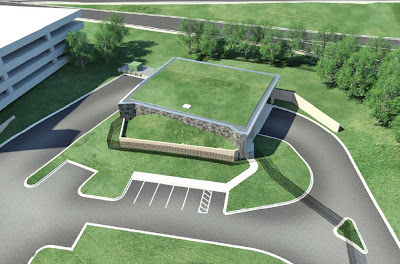
 two above-grade and five below, but with an expanded footprint. The garage will provide 1,973 parking spaces and will serve both the USCG and the Department of Homeland Security headquarters. The exterior of the garage on the northern facade now swaps an extended green wall system with the previous zinc-clad frame.
Finally, though the original Master Plan created a security perimeter that excluded the historic cemetery, new plans include the cemetery within the security perimeter to restore it "to its place as an integral part of the West Campus."
two above-grade and five below, but with an expanded footprint. The garage will provide 1,973 parking spaces and will serve both the USCG and the Department of Homeland Security headquarters. The exterior of the garage on the northern facade now swaps an extended green wall system with the previous zinc-clad frame.
Finally, though the original Master Plan created a security perimeter that excluded the historic cemetery, new plans include the cemetery within the security perimeter to restore it "to its place as an integral part of the West Campus."


